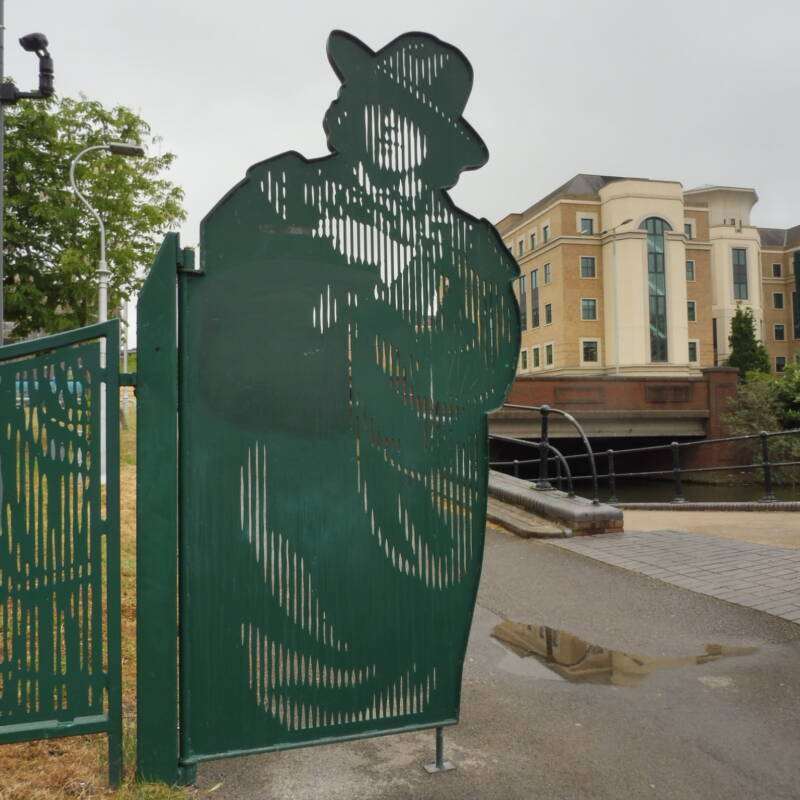
Gate at the Oscar Wilde Walk, near the former Reading Prison
© Kim Tame, 2022
While researching for my book, Devoted; the Life and Times of Emilia Vincent of Westminster and Reading, I kept finding stories that I wanted to follow up, but then had to be strict with myself about what could be included. Many stories thus ended up on the cutting-room floor.
One of these cutting-room floor stories is about Oliver Calley Maurice (1838-1909), who was honorary surgeon to Emilia Vincent's nursing home, when she first opened for business in Jesse Terrace, and later, when the home moved to Brownlow Road.
Mr. Maurice was born into a family of doctors and began his studies at a young age. He trained at St. Thomas’ Hospital in London, and at Heidelburg and Paris. In 1860, he qualified as a Member of the Royal College of Surgeons (MRCS) and as a Licenciate of the Society of Apothecaries (LSA)[1].
By 1861, at the age of 23, he was practising private medicine with his uncle, Dr. Thelwall Maurice, at 96 London Street, Reading, and was also a house surgeon at the Royal Berkshire Hospital.[2] He continued to gain in experience with a string of part-time and honorary appointments; he served as medical officer to Reading Blue Coat School, Reading School and Reading Borough Police, as Assistant Surgeon to 1st Royal Berkshire Volunteers, acted for insurance companies such as the National Provident, was a Fellow of the Obstetrical Society, the Medical Society, Reading Pathological Society and the British Medical Association. Last but not least, he served as Surgeon to Reading Gaol[3]. Somehow, he also found the time to be a Justice of the Peace and churchwarden at St. Giles Church, Reading.
In 1865, with a rising career and excellent prospects, he married Ada Pierce Hobbs at Reading Minster, and they subsequently had six children, five sons and one daughter. Tragedy and then scandal enveloped the family.

The Maurice family home at 75 London Street, Reading.
© Kim Tame, 2022
Theirs could not be the first or the last marriage to be split apart by the loss of a child. The death of their fourth son, Charles, at the age of 2 in 1875 was perhaps the reason for Ada's increasing alcohol consumption, and then becoming involved with another man[4].
The scandal was reported in the Reading Mercury in February 1878; Mr. Maurice had applied for a divorce, citing a Mr. Frederick Pain as co-respondent. Mr. Maurice successfully applied for custody of the five children.
Among his medical appointments, he took on some very different roles. As honorary physician to the Helena Nursing Home, he was overseeing the medical care of mostly middle-class and middle-aged to elderly women who were terminally ill or living with long-term conditions. He performed this role for many years, and seems to have become good friends with Emilia and her helpers. It could perhaps be said that they understood each other; they were of similar social status, and Emilia's residents, brought up to be deferential to men, were probably among his easier patients.
Over at Reading Gaol, on the other hand, were the rough, ill-educated convicts, serving sentences for anything from petty theft to murder. There was no segregation of prisoners at that time; men, women, children, those with mental illnesses and learning disabilities were all subjected to the same brutal regime.
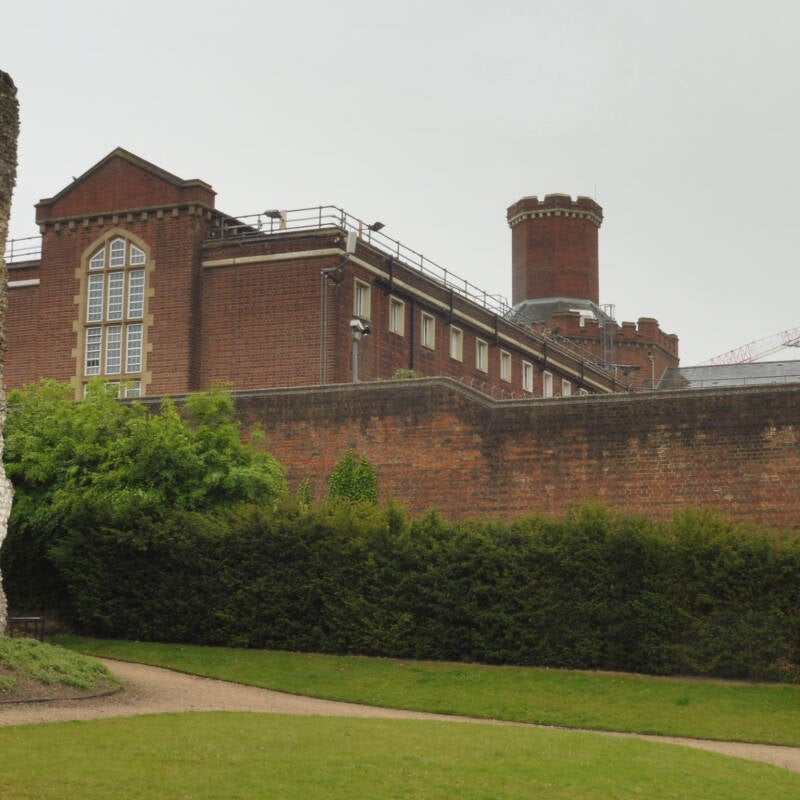
Reading Prison, as seen from Reading Abbey gardens
© Kim Tame, 2022
In November 1895, Oscar Wilde was transferred to Reading from Wandsworth Prison, six months into his two-year sentence for gross indecency; the harsh regime and poor diet had already made him ill, and he had collapsed in the chapel and suffered a ruptured ear drum in the fall. It was in the infirmary at Reading that he first met Mr. Oliver Calley Maurice, and was not happy with how he was treated - or rather, not treated.
Wilde wrote to the Home Secretary on 2 July 1896, complaining that he had an abscess in his right ear, and was now almost totally deaf, but the only treatment he had received was that the ear had been syringed with plain water three times.
Maurice responded to the complaint that there was only a slight perforation of the ear drum of the right ear, nothing wrong with the left, and no defect in his vision, as if that was also relevant[5].
Meanwhile, another prisoner arrived at Reading Gaol; Trooper Charles Thomas Wooldridge, formerly of the Royal Horseguards, who had killed his wife, Laura, at Clewer, Berkshire. He was held at Reading pending his trial, and returned to Reading afterwards to await his sentence of death.
On the appointed day, 7 July 1896, Mr. Maurice was among the witnesses to the execution. The hangman was James Billington, and the Governor, Colonel Isaacson, and the chaplain, Rev. M.T. Friend, also stood by. Wooldridge was said to be resigned to his fate; he ate a small breakfast, and offered not the least amount of resistance when Billington entered his cell and his arms were pinioned. His life ended punctually at 8am[6] and Mr. Maurice, as prison surgeon, certified the death.
The case was to inspire Oscar Wilde to write The Ballad of Reading Gaol; in the meantime, he was still waiting for a second opinion about his ear. Local doctor, Dr. J.A. Price, came to the prison on 2 August. Dr. Price recorded that there was perforation of the left tympanic membrane and recommended daily syringing of the ear with dilute carbolic lotion. He was talking about the wrong ear - Wilde's problem was with the right ear - but he did at least get some treatment that relieved the symptoms. However, the infection was repeatedly to recur.
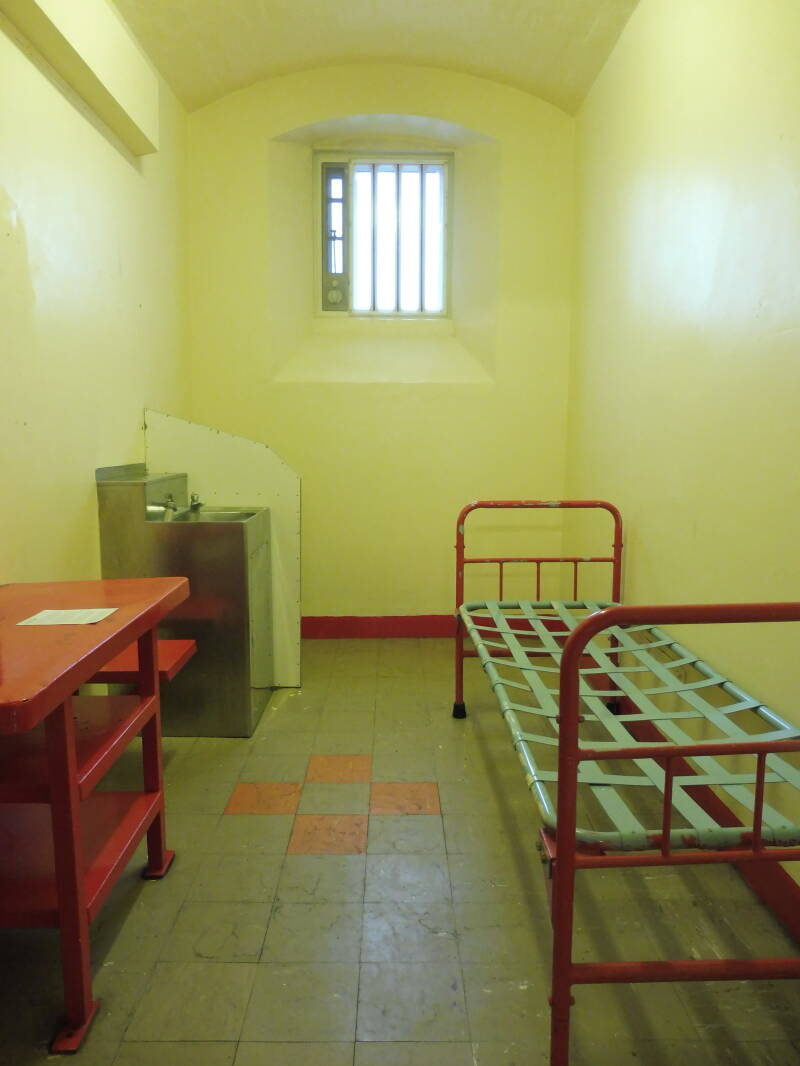
Oscar Wilde's cell at Reading Prison, as it appeared in September 2016
© Kim Tame, 2022
After his release, Wilde moved to Paris, and was to give vent to his feelings about his treatment in prison, with a letter to the Daily Chronicle, which was published on 23 March 1898. In the letter, he complained that "the present prison system seems almost to have for its aim the wrecking and the destruction of the mental faculties." He wrote of three principle hardships;
- Hunger, since the food "in most cases consists of weak gruel, suet and water," which led to almost constant diarrhoea.
- Insomnia, since the bed was a hard plank, at some point supplemented by a hard mattress during the course of the sentence.
- Disease, since not only were the conditions conducive to degradation and depression, "the health of the prisoners is entirely neglected and the sanitary condition of the prisoners entirely overlooked".
He was scathing about the men in the two roles that should have been about prisoner welfare; the chaplains, whom he described as "well-meaning, foolish, indeed, silly, men. They are of no help to any prisoner;" and the prison doctors. They were "brutal in manner, coarse in temperament and utterly indifferent to the health of the prisoners or their comfort[7]."
By September 1900, the ear infection had progressed to a life-threatening level, and Wilde underwent surgery under chloroform in his Paris hotel room. Afterwards, he was in considerable pain, and needed daily dressings and injections of morphine. He seemed to improve slightly, but in November, was giddy and light-headed, and unable to get out of bed. He was treated with icepacks and leeches applied to the head, but died on 30 November.
The lack of medical records for what had occurred in Paris later allowed Arthur Ransome (best known as the author of Swallows and Amazons) to write a biography of Oscar Wilde in which he claimed that his death was caused by meningitis as a consequence of tertiary syphilis, and hastened by his heavy drinking[8].
He had not a shred of evidence for his claim, but it was not until 1982 that a medical certificate turned up at auction at Sotheby’s in London. It had been issued jointly by Dr. Maurice a’Court Tucker, who was the British Embassy Doctor in Paris, and Wilde’s regular doctor during his residence there, and Dr. Paul Claisse, a distinguished French doctor. The two doctors had found “serious cerebral disturbances resulting from a long-standing suppuration of the right ear… The diagnosis of meningoencephalitis must be made without doubt.”
It seems likely, then, that the operation Wilde underwent was some variety of radical mastoidectomy, a risky surgery aimed at removing the infection[9]. The availability of antibiotics these days means that ear infections can be treated effectively at a much earlier stage, and such operations are rarely necessary.
Oliver Calley Maurice continued working as a doctor almost until the end of his life, and died at his home at 75 London Street, Reading, in 1907, at the age of 69. The parishioners of St. Giles Church, Reading, where he had been churchwarden for 12 years, subscribed to a memorial fund, and raised £90 as reported in the Berkshire Chronicle of 6 February 1909. A carved and traceried English oak screen was installed in his memory. It still stands under the tower at the west end of the church, together with an adjacent plaque.
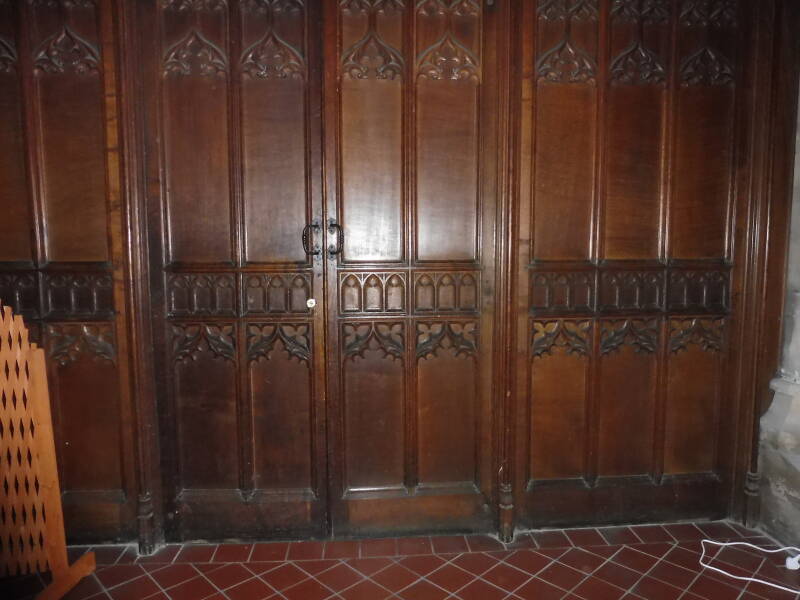
The oak screen, in memory of Dr. Oliver Calley Maurice, at St. Giles Church, Southampton Street, Reading
© Kim Tame, 2022
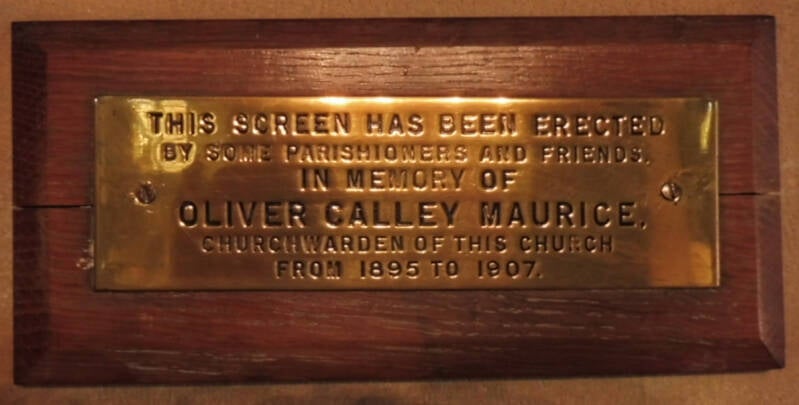
...and the plaque, which is on the wall to the right of the screen
© Kim Tame, 2022
References;
[1] Maurice, Dick. The Marlborough Doctors. Stroud, Alan Sutton Publishing. 1994, p.22
[2] 1861 census
[3] The Medical Directory, 1905
[4] Family documents available at ancestry.com
[5] Robins, AH and Sellars, SL. Oscar Wilde’s Terminal Illness; reappraisal after a century. The Lancet, Vol. 356, 25 November 2000
[6] Windsor and Eton Express, 11 July 1896
[7]Turner, M. W., Stokes, J., Jackson, R., Guy, J. M., Bristow, J., Wilde, O., Donohue, J. W., Small, I., Beckson, K., Fong, B. (2000). The Complete Works of Oscar Wilde: De profundis, "Epistola : in carcere et vinculis". UK: Oxford University Press.
[8] Ransome, Arthur. Oscar Wilde, A Critical Study. 1912, p.199
[9] Robins, AH and Sellars, SL. Oscar Wilde’s Terminal Illness; reappraisal after a century. The Lancet, Vol. 356, 25 November 2000
Add comment
Comments